


More on Retention of Critical Life Saving Skills Over Time.

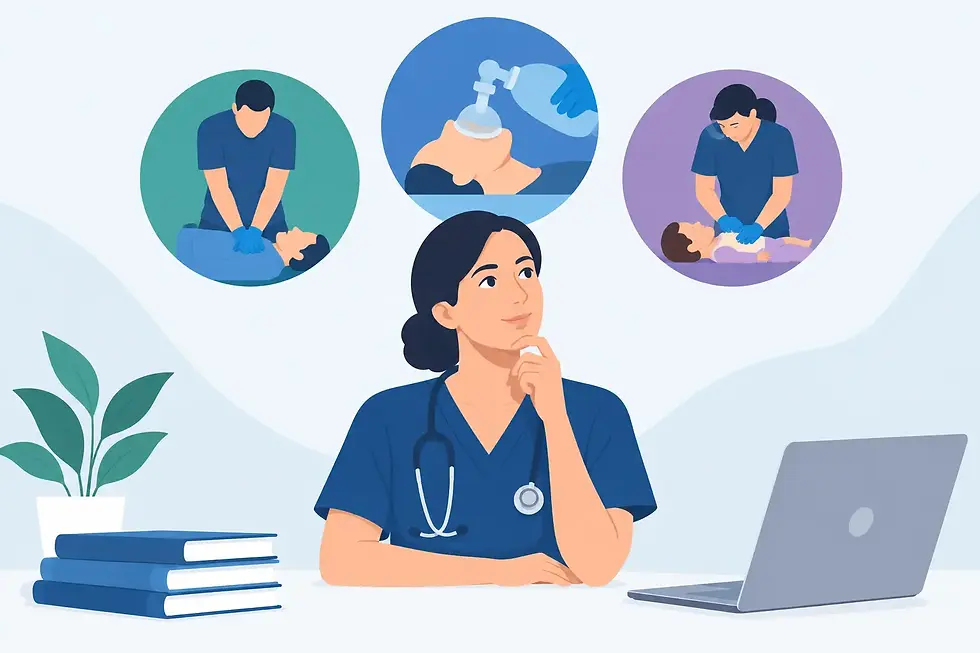
The American Heart Association in their 2015 guidelines again notes that retention of life saving CPR skills and knowledge is a significant problem for both lay rescuers and healthcare providers. Retention of CPR (both BLS and ACLS) skills over time has long been known to suffer.
For example, Ackerman (2009) noted that knowledge retention of key aspects of high quality CPR decreased significantly within 3 months in both a standardized CPR trained group, and one trained using high fidelity simulation.
Burkhardt, Glick, and Terndrup (2014) performed a study showing that CPR knowledge retention significantly improved performance skills. Therefore knowledge retention equals skills retention. The conclusion is that more consistent reinforcement may help, as generally, even experienced providers performed sub-optimal CPR.
In a similar study by Montgomery, Kardong-Edgren, et al, (2012), students were randomized into Heartcode BLS groups and instructor led groups. Students were more satisfied with the instructor led groups, but ultimately, the students that felt most confident in CPR skills were those with monthly refreshers.
A significant amount of research has gone into identifying the type of training which may lead to more knowledge and skills retention- instructor led, versus voice activated manikins, high or low fidelity simulation, but there is a growing body of research that suggests perhaps the more important component of skills retention is not how a student is trained, but how OFTEN.
Traditional AHA CPR certification requires re-training every 2 years, but with multiple studies(Ackerman, etc.) showing significant reduction in skills mastery and knowledge retention within 3 months, research has taken on the question of how to maintain those skills several months out from a required 2 year CPR refresher.
Sutton et al (2011) showed that brief, frequent (monthly) skills re-training sessions significantly boosted CPR quality in skills sessions. Instructor led re- training was better than automated feedback training alone.
Sullivan (2015) after a review of a large number of CPR retention articles, ultimately found that all types of learning were generally effective at providing initial skills. Studies showed the largest retention of skills when provided brief, frequent refreshers. Either high or low fidelity simulation sessions, followed by debrief and repeat practice aid in knowledge and skills retention over time.
Perhaps it is time to re-think traditional 2 year CPR training, and provide the opportunity for staff to practice regularly on their unit by participating in mock codes, or even using a voice assisted manikin during breaks in patient care.
Learn, Enjoy and Save Life. HealthForce Training Center offer services such as Basic Life Support (BLS), Advance Cardiovascular Life Support (ACLS), Pediatric Advance Life Support (PALS), CPR AED, Pediatric First Aid CPR AED and First Aid CPR AED. Read more of our blogs.
Source(s):
References
Ackermann, A. D. (2009). Investigation of learning outcomes for the acquisition and retention of CPR knowledge and skills learned with the use of high-fidelity simulation. Clinical Simulation in Nursing, 5(6), e213-e222. http://dx.doi.org/10.1016/j.ecns.2009.05.002
Burkhardt, J. N., Glick, J. E., & Turndrup, T. E. (2014). Effect of prior cardiopulmonary resuscitation knowledge on compression performance by hospital providers. The Western Journal of Emergency Medicine, 15(4), 404-408. http://dx.doi.org/10.5811/westjem.2014.1.19636
Montgomery, C., Kardong-Edgren, S. E., Oermann, M. H., & Odom-Maryon, T. (2012). Student satisfaction and self report of CPR competency: HeartCode BLS courses, instructor-led CPR courses, and monthly voice advisory manikin practice for CPR skill maintenance. International Journal of Nursing Education Scholarship, 9(1), 1-13. http://dx.doi.org/10.1515/1548-923X.2361
Oermann, M. H., Kardong-Edgren, S., Odom-Maryon, T., Hallmark, B. F., Hurd, D., Rogers, N., ... Smart, D. A. (2011). Deliberate practice of motor skills in nursing education: CPR as exemplar. Nursing Education Perspectives, 32(5), 311-315. http://dx.doi.org/10.5480/1536-5026-32.5.311
Sullivan, N. (2015). An integrative review: Instructional strategies to improve nurses’ retention of cardiopulmonary resuscitation priorities. International Journal of Nursing Education Scholarship, 12(1), 1-7. http://dx.doi.org/10.1515/ijnes-2014-0012
Sutton, R. M., Niles, D., Meaney, P. A., Aplenc, R., French, B., Abella, B. S., ... Nadkarni, V. (2011). Low-dose, high-frequency CPR training improves skill retention of in-hospital pediatric providers. Pediatrics, 128(1), e145-e151. http://dx.doi.org/10.1542/peds.2010-2105
Travers, A. H., Rea, T. D., Edelson, B. J., Berg, D. P., Sayre, M. R., Berg, M. D., ... Swor, R. A. (2010). Part 4: CPR overview: 2010 American Heart Association guidelines for cardiopulmonary resuscitation and emergency cardiovascular care. Circulation, 122(3), S676-S684. http://dx.doi.org/10.1161/CIRCULATIONAHA.110.970913


The idea of following curiosity through everyday information gives me a reason to slow down and consider the details. A clear question can turn a casual interest into something easier to explore. That practical perspective helps me frame Hebeizc learning ideas as a theme for Hebeizc. A simple comparison would help me picture the differences without rushing towards a fixed answer. How do you decide which detail deserves a closer look before moving on?
Khi quan sát JILIWIN ở góc độ tổ chức nội dung, mình nhận thấy nền tảng chú trọng khá nhiều vào sự phân tách rõ ràng giữa các sảnh giải trí. Khu vực casino, game bài và thể thao đều được bố trí theo từng nhóm riêng nên việc định vị nội dung trở nên nhanh hơn. Mình thấy cách hiển thị này giúp giảm thời gian tìm kiếm và hạn chế thao tác thừa trong quá trình sử dụng. Bên cạnh đó, giao diện vẫn giữ được sự cân bằng giữa nội dung và khoảng trống, tạo cảm giác thoáng hơn khi theo dõi nhiều mục cùng lúc, tổng thể khá dễ tiếp cận.
What interests me about reading news and commentary more carefully is how a broad idea becomes part of an ordinary day. A striking headline is easier to evaluate when its main claim is separated from the supporting detail. It is the kind of question I would keep in mind when thinking about Haberyerin and news and media literacy. The smaller details are what I would want to return to, especially when an explanation feels too broad. What would you check before passing a story on to someone else?
Considering following curiosity through everyday information, I would want to understand a few concrete details before deciding what matters most. A clear question can turn a casual interest into something easier to explore. With Gdjhzhwl in mind, Gdjhzhwl learning ideas feels like a topic worth exploring one question at a time. It leaves me curious about the steps between understanding an idea and putting it into practice. How do you decide which detail deserves a closer look before moving on?
Khi quan sát lô đề online ở góc độ tổ chức nội dung, mình nhận thấy nền tảng chú trọng khá nhiều vào sự phân tách rõ ràng giữa các sảnh giải trí. Khu vực casino, game bài và thể thao đều được bố trí theo từng nhóm riêng nên việc định vị nội dung trở nên nhanh hơn. Mình thấy cách hiển thị này giúp giảm thời gian tìm kiếm và hạn chế thao tác thừa trong quá trình sử dụng. Bên cạnh đó, giao diện vẫn giữ được sự cân bằng giữa nội dung và khoảng trống, tạo cảm giác thoáng hơn khi theo dõi nhiều mục cùng lúc, tổng thể khá dễ tiếp cận.