


BLS Versus CPR Certification for Your Career
A job posting says “BLS required,” but the course page offers CPR certification. Choosing based on the shortest class can leave you with a credential your employer will not accept. Understanding BLS versus CPR certification before you enroll saves time, avoids repeat training, and ensures you are prepared for the emergencies you may actually face.
For many learners, the choice is straightforward: healthcare professionals and students usually need BLS, while parents, babysitters, workplace teams, and community members may need a CPR course. The deciding factor, however, is not the course name alone. It is the role you hold, the population you serve, and the credential standard set by your employer, school, clinical site, or licensing organization.
BLS Versus CPR Certification: The Core Difference
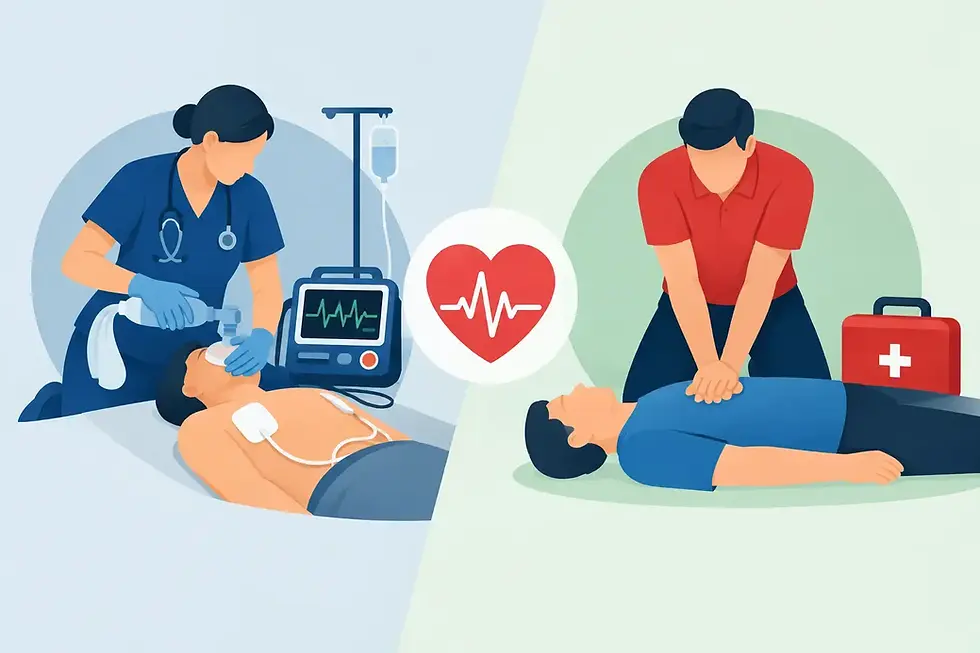
CPR is a life-saving skill. BLS, or Basic Life Support, is a healthcare-focused credential that includes CPR while adding the team-based skills used in clinical and prehospital settings. Put simply, BLS training includes CPR, but a general CPR certification is not always equivalent to BLS certification.
A CPR course is designed for people who may respond before professional help arrives. It typically teaches recognition of cardiac arrest, chest compressions, rescue breaths, AED use, choking relief, and emergency response steps. Depending on the course selected, instruction may cover adults only or include children and infants. First Aid may be included as part of a combined course, but it is a separate skill set from CPR.
BLS certification is intended for healthcare providers and healthcare-bound learners. It addresses high-quality CPR for adults, children, and infants, effective use of an AED, rescue breathing, relief of choking, and the roles of multiple rescuers. Learners practice working as part of a coordinated response team, including communication, role assignment, rapid intervention, and patient handoff considerations.
That difference matters when seconds count. A solo responder may need to start compressions and use an AED until EMS arrives. A nurse, medical assistant, dental professional, EMT, or clinical student may need to function within a team where one person gives compressions, another manages ventilation, and another prepares the AED or communicates with emergency services.
Who Usually Needs BLS Certification?
BLS is commonly required for nurses, physicians, EMTs, paramedics, medical assistants, dental professionals, respiratory therapists, pharmacy staff, allied health professionals, private-duty aides, and home-care workers. Nursing, medical, and other clinical students are also often required to hold a current BLS credential before beginning clinical rotations.
Your employer or school may specify the accepted provider, course format, and required card. For example, a hospital may require an American Heart Association-aligned BLS course with an in-person skills assessment, while a private practice may state only that a current BLS credential is required. Read the requirement carefully before booking.
BLS is also the safer choice if you are entering healthcare and are unsure which credential you will need. A general CPR course may teach valuable emergency skills, but it may not meet onboarding or clinical-placement standards. Do not assume that “CPR certified” on a course description means the course satisfies a BLS requirement.
What BLS Training Emphasizes
BLS goes beyond knowing the basic compression rate and AED prompts. It focuses on delivering consistent, high-quality care under pressure. Learners practice skills such as minimizing interruptions in compressions, providing effective ventilation, recognizing when to switch rescuers to prevent fatigue, and using clear team communication.
Training also addresses emergencies across age groups. Infant and child response techniques differ from adult techniques, and healthcare personnel may encounter patients of every age. This broad clinical focus is one reason BLS is usually required in patient-facing settings.
Who Should Choose CPR Certification?
CPR certification is a strong fit for people who want practical emergency readiness without a healthcare-provider credential. Parents, grandparents, babysitters, coaches, teachers, fitness instructors, security personnel, workplace teams, and community members can all benefit from learning how to respond to cardiac arrest and choking.
Child-care professionals may need pediatric CPR and First Aid because they work with infants and children. A course that includes adult, child, and infant CPR can be especially useful for caregivers, although a licensing agency or employer may require a specific pediatric curriculum. Always confirm the requirement before enrolling.
For many nonclinical learners, a combined CPR and First Aid course offers the most useful preparation. CPR helps you respond to cardiac arrest and choking. First Aid prepares you for common injuries and sudden illnesses, such as bleeding, burns, allergic reactions, seizures, or heat-related illness. The right combination depends on the setting where you work or care for others.
A community CPR course is not a lesser choice. It is a different credential designed for a different responsibility level. A parent who acts quickly during a choking emergency is providing meaningful, life-saving care. The course simply does not need the same clinical and team-response components required in hospitals, ambulances, and medical offices.
How to Choose the Right Course Without Guesswork
Start with the written requirement from your employer, school, agency, or licensing board. Look for exact language such as “BLS for Healthcare Providers,” “CPR/AED,” “Pediatric CPR/First Aid,” or “American Heart Association required.” If the wording is unclear, ask the credentialing contact before registering. One quick question can prevent you from paying for the wrong class.
Next, consider the environment where you will use the skill. If you provide direct patient care, work in a medical setting, or plan to enter a healthcare program, choose BLS unless your organization specifically directs you otherwise. If you are preparing for home, school, child care, a gym, or a general workplace, CPR or CPR/First Aid may be the appropriate path.
Then choose a delivery format that supports successful completion. Instructor-led classroom sessions provide guided learning and hands-on practice in one visit. Blended learning can allow you to complete the knowledge portion online before attending an in-person skills session. Self-guided pathways with a CPR Verification Station may offer added scheduling flexibility for eligible learners who need skills validation on their own timetable.
Convenience should not come at the expense of acceptance. A fully online course without a recognized hands-on skills component may not meet employer, clinical, or licensing requirements. For regulated roles, confirm that the format, skills check, and course completion card align with the standard you must meet.
Certification Length, Renewal, and Proof of Completion
Most American Heart Association course completion eCards are valid for two years from the date of successful completion. Your workplace may set an earlier renewal deadline to avoid any lapse, particularly if scheduling, onboarding, or compliance audits are involved. Put the expiration date on your calendar as soon as you receive your card.
If your card has expired, do not assume every renewal option is available. Some providers allow experienced learners to take a renewal course if eligibility requirements are met, while others may require initial training after a long lapse. The best choice depends on your current credential, your organization’s policy, and how long you have been out of date.
Prompt proof of completion matters for more than convenience. Students may need an active card before a clinical rotation starts. New hires may need it before orientation. Healthcare workers may need to submit documentation before a shift assignment or compliance deadline. Same-day eCard delivery after successful course completion can make a meaningful difference when time is tight.
Get the Credential Your Role Requires
The best course is the one that matches your real responsibility. Do not select BLS simply because it sounds more advanced if a workplace CPR course is all you need. At the same time, do not choose a general CPR class when a healthcare employer requires BLS. The wrong credential can delay a job start, clinical placement, or license renewal.
HealthForce Training Center helps busy learners complete recognized emergency training through instructor-led, blended, and skills-validation options built around real schedules. Whether you need an initial credential, a renewal, or a course for family readiness, start by confirming the requirement and selecting the pathway that gets you there with confidence.
A current card is valuable, but the real value is being ready to act. Choose the training that fits your role, practice the skills seriously, and keep your certification active before the next emergency asks you to step forward.


Comments