


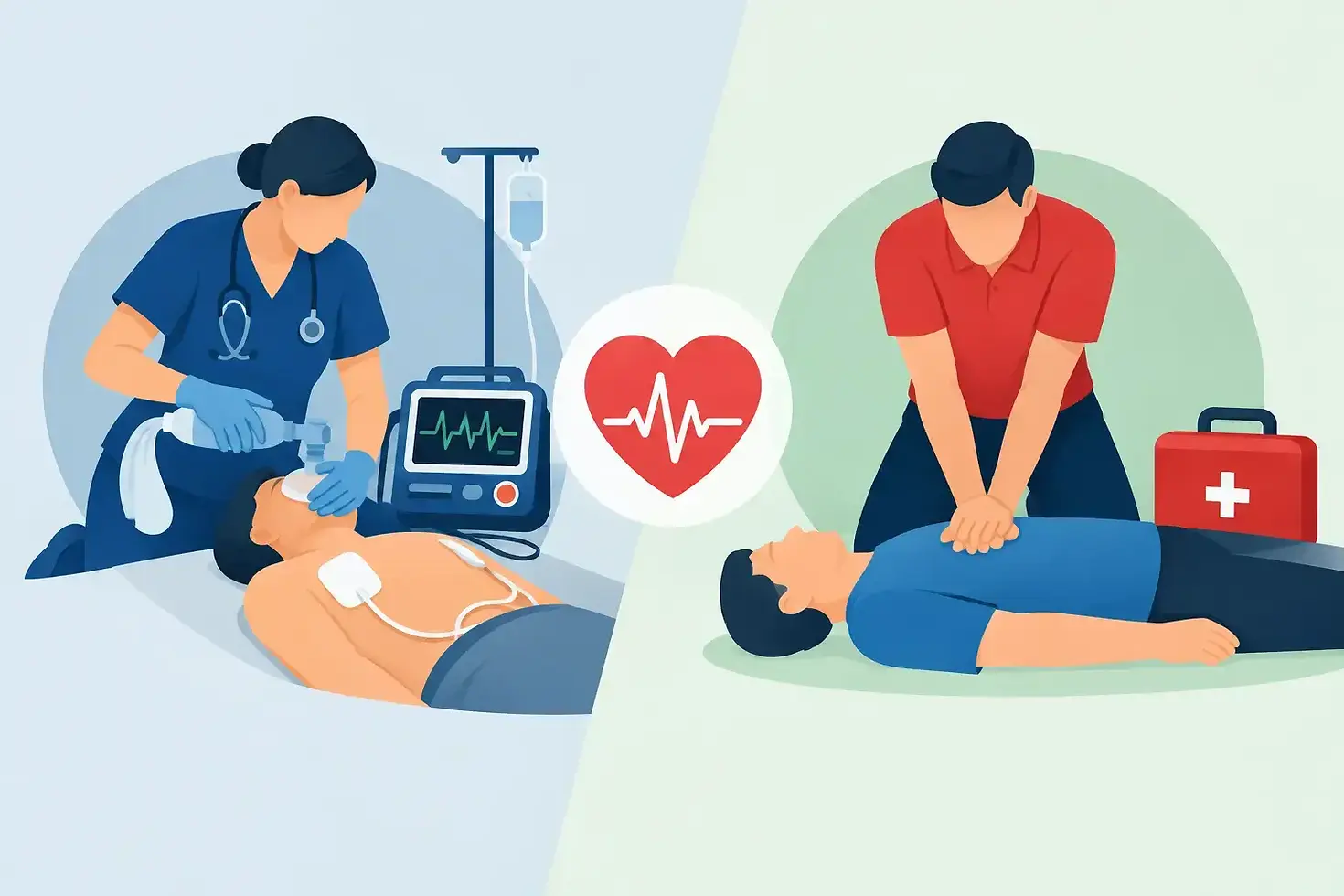
ACLS Versus BLS Training: Which Do You Need?
A new job offer, clinical placement, or credential renewal can create one urgent question: which course do you actually need? ACLS versus BLS training is not a choice between two interchangeable CPR cards. Each course prepares you for a different level of emergency response, and choosing the wrong one can delay your start date or leave you short of an employer requirement.
For most healthcare professionals, BLS is the foundation. ACLS is the advanced credential required for clinicians who lead or participate in the management of cardiovascular emergencies. The right path depends on your role, work setting, employer policy, and whether you are earning a credential for the first time or renewing one that is about to expire.
What BLS Training Prepares You to Do
Basic Life Support, or BLS, teaches healthcare providers how to respond quickly when a patient has no pulse, is not breathing normally, or is choking. It focuses on immediate, high-quality actions that sustain circulation and breathing until advanced care is available.
A BLS course covers adult, child, and infant CPR; proper use of an automated external defibrillator, or AED; relief of choking; rescue breathing; and team-based response skills. Learners practice how to recognize cardiac arrest, activate the emergency response system, deliver effective compressions, and work efficiently with other rescuers.
BLS is commonly required for nurses, medical assistants, dental professionals, EMTs, home health staff, nursing and medical students, technicians, and many allied health roles. It may also be required for employees who work in outpatient offices, clinics, long-term care, rehabilitation, and ambulatory settings.
The course is practical by design. In a real cardiac arrest, the first few minutes matter. BLS training helps responders act with confidence before a code team, emergency department, or advanced life-support provider takes over.
What ACLS Training Adds Beyond BLS
Advanced Cardiovascular Life Support, or ACLS, builds on the skills taught in BLS. It is designed for healthcare professionals who may manage or participate in the care of adults experiencing cardiac arrest, dangerous heart rhythms, stroke, acute coronary syndromes, or other cardiopulmonary emergencies.
ACLS goes beyond CPR technique. Learners must understand how to assess a deteriorating patient, recognize cardiac rhythms, apply treatment algorithms, manage airways, use a team-based approach during a code, and make clinical decisions under pressure. The curriculum commonly includes pharmacology concepts, electrical therapies, post-cardiac-arrest care, and communication during resuscitation events.
This is why ACLS is often required for emergency department nurses, ICU and critical-care staff, physicians, paramedics, respiratory therapists, anesthesia professionals, and clinicians working in hospital-based acute care. Some telemetry, procedural, transport, and specialty units also require it.
ACLS is not simply “BLS with more material.” It assumes you can already perform high-quality CPR and participate effectively in a basic resuscitation response. During an ACLS scenario, the team must still provide excellent compressions, timely defibrillation, ventilation, and coordinated care. Advanced interventions cannot compensate for weak fundamentals.
ACLS Versus BLS Training: Key Differences
The clearest difference is the scope of responsibility. BLS prepares you to recognize an emergency and provide immediate life-saving care. ACLS prepares qualified healthcare professionals to assess more complex cardiovascular emergencies and follow advanced treatment pathways as part of a resuscitation team.
The expected learner also differs. BLS is appropriate for a broad range of healthcare workers and healthcare-bound students. ACLS is intended for professionals whose clinical role includes advanced emergency response, code participation, or critical-care decision-making. A medical assistant in a primary care office may need BLS but not ACLS. An emergency department nurse will commonly need both.
Course content and preparation time differ as well. BLS emphasizes hands-on skills practice and a focused written assessment. ACLS requires a stronger clinical knowledge base, familiarity with advanced algorithms, rhythm recognition, and participation in team scenarios. For an initial ACLS course, reviewing the required materials before class can make a meaningful difference in your confidence and performance.
Neither credential automatically replaces the other. Many employers specifically list BLS and ACLS as separate requirements. If your role requires ACLS, you may still need a current BLS credential. Always confirm the exact credential, provider requirements, and renewal timeline with your employer, school, licensing body, or clinical coordinator before enrolling.
How to Choose the Right Course for Your Role
Start with the requirement, not the course title. Look at your offer letter, employee onboarding checklist, clinical placement documents, or department policy. If the document says “BLS for Healthcare Providers,” choose BLS. If it lists ACLS, determine whether you also need BLS, as many acute-care roles require both credentials.
If you are entering healthcare, BLS is usually the first credential to obtain. It is frequently required before clinical rotations, externships, and entry-level healthcare employment. Students should verify whether their program requires a particular course format or credentialing organization before registering.
If you are moving into a hospital, emergency, critical-care, transport, procedural, or advanced practice role, ACLS may be part of your onboarding requirements. Do not assume that an ACLS course alone will meet every requirement. Your department may also require BLS, PALS, neonatal resuscitation, or other specialty education based on patient population and responsibilities.
For nonclinical community learners, parents, babysitters, and workplace responders, a CPR and First Aid course may be a better fit than BLS or ACLS. BLS is a professional healthcare course, while ACLS is an advanced clinical credential. Taking more training than your role requires is not always the most efficient use of your time.
Initial Certification and Renewal Are Not Always the Same
Your course selection should also reflect whether you are certifying for the first time or renewing a current credential. Renewal courses are intended for learners who hold a valid, unexpired credential and need to maintain it. If your card has expired, your employer or course provider may require you to complete an initial course instead.
Do not wait until the last week before expiration to check your status. Scheduling availability, employer verification, pre-course work, and skills testing can all affect how quickly you complete the process. Keeping a reminder 60 to 90 days before your expiration date gives you more course-format options and reduces the risk of a lapse.
Busy professionals may benefit from a format that fits around shifts and family responsibilities. Depending on course availability and credential requirements, options can include instructor-led classes, accelerated courses, blended online learning with an in-person skills session, or self-guided pathways followed by verified skills testing. The right format is the one that meets your employer’s requirements and gives you adequate opportunity to demonstrate the required skills.
What to Expect After Successful Completion
A recognized healthcare credential should provide clear proof of completion for your employer or school. Confirm how and when your completion documentation will be delivered, how long the credential remains valid, and whether you need to submit it through an onboarding portal.
At HealthForce Training Center, learners can choose convenient course formats designed around real schedules, with certified instruction, hands-on skills validation, and prompt digital credential delivery after successful completion. Small class settings can also give learners more time to ask questions, practice skills, and prepare for the situations they may face at work.
Your best next step is simple: review the exact requirement for your role, check the expiration date on any current card, and register for the course that matches both. A current credential is more than a hiring checkbox. It is preparation to respond when a patient, coworker, or community member needs immediate help.


Comments