


What to Expect at a HeartCode BLS Skills Session
Your HeartCode BLS skills session is the hands-on step that turns online coursework into a completed life-support credential. For busy nurses, medical assistants, EMS professionals, students, and other healthcare providers, it is where you demonstrate that you can perform critical BLS actions correctly, confidently, and in the proper sequence.
HeartCode BLS combines self-paced online learning with an in-person or guided skills evaluation. That format can save time for professionals balancing shift work, clinical rotations, family responsibilities, and renewal deadlines. But the flexibility of online learning does not remove the need for practical performance. The skills session is designed to confirm that you can apply what you learned when seconds matter.
How the HeartCode BLS Format Works
The HeartCode BLS pathway typically has two parts. First, you complete the assigned online course modules. These modules cover the knowledge behind high-quality CPR, use of an AED, relief of choking, team dynamics, and the BLS response sequence for adult, child, and infant patients.
After completing the online portion, you receive proof of completion or a certificate that is needed for the skills evaluation. Keep it available on your phone or bring a printed copy, based on your training center's instructions. Without documentation that the online portion is complete, a skills-only appointment may need to be rescheduled.
The second part is the skills session. Depending on the selected pathway and local availability, this may be completed with a certified instructor or through a CPR Verification Station that provides guided practice, objective feedback, and documented performance validation. HealthForce Training Center offers flexible options designed to help eligible learners complete this final requirement efficiently.
The best format depends on your employer, school, licensing board, and personal learning needs. Some learners prefer the direct support of an instructor, especially if they are new to BLS or have not practiced recently. Others value the speed and scheduling flexibility of a self-guided skills station. Before booking, confirm what your organization accepts and whether you need initial certification, renewal, or a skills-only appointment.
What Happens During a HeartCode BLS Skills Session
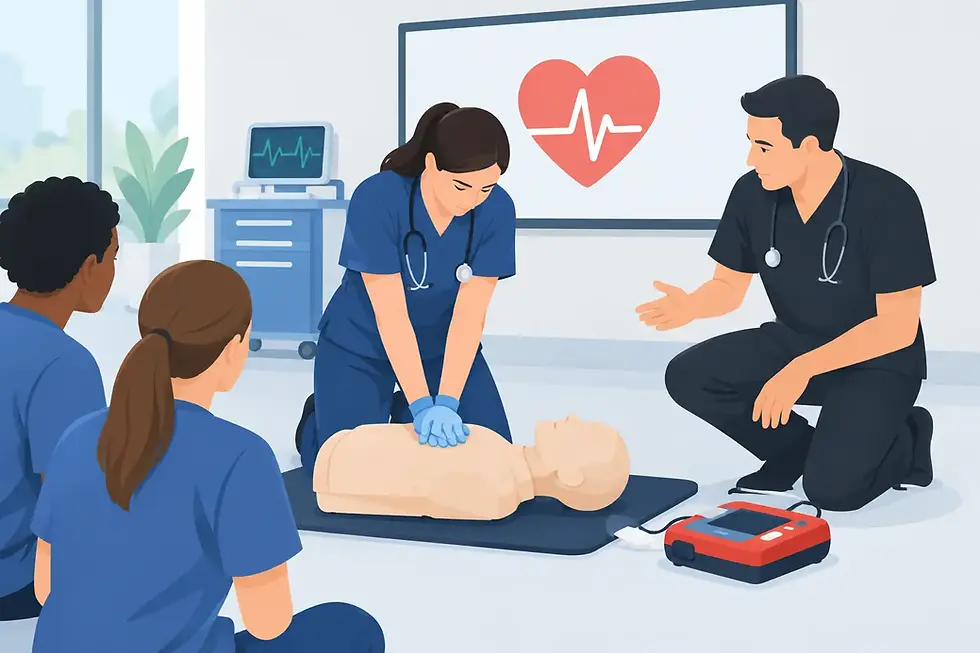
A skills session is focused, practical, and performance-based. You will not spend the appointment repeating the full online course. Instead, you will demonstrate key BLS skills using training manikins, an AED trainer, and other required equipment.
Expect to practice and be evaluated on adult CPR, including correct hand placement, compression rate, compression depth, full chest recoil, and minimizing pauses. You may also demonstrate rescue breaths with a barrier device or bag-mask device, based on the course requirements and your provider role.
Child and infant CPR are also central to BLS training. These scenarios require different hand techniques and compression methods, so take time to review them before your appointment. You may be asked to perform one-rescuer and team-based response skills, including when and how to switch compressors during a multi-rescuer event.
AED use is another critical component. You will show that you can turn on the device, apply pads appropriately, follow prompts, keep the scene clear during analysis and shock delivery, and immediately resume CPR. The AED trainer does not deliver a real shock, but your actions should reflect the same safety standards you would use in an actual emergency.
Choking response skills may be included for adults, children, and infants. You may also be evaluated on recognizing cardiac arrest, activating the emergency response system, and communicating effectively with a partner during a resuscitation scenario.
Why feedback matters
High-quality CPR is measurable. A compression that is too shallow, too slow, too fast, or interrupted for too long may not provide effective blood flow during cardiac arrest. That is why modern training equipment gives feedback on compression quality and ventilation performance.
Use that feedback as coaching, not as a reason to rush. If a skill needs correction, you may have an opportunity to practice again. The goal is not simply to complete a station. It is to leave knowing how to perform the steps correctly under pressure.
How to Prepare Before Your Appointment
Preparation keeps your skills session fast, easy, and fully guided. Finish the assigned online HeartCode BLS course before arriving, and verify that your completion document is accessible. Review any instructions sent with your appointment confirmation, including arrival time, location, identification requirements, and what to bring.
Wear comfortable clothing. You will likely spend time kneeling or standing beside a manikin and performing repeated chest compressions. Clothing that allows easy movement will make the session more comfortable.
It also helps to review the core BLS sequence before your appointment. Focus on recognizing an unresponsive patient, calling for help, getting an AED, starting quality compressions, giving breaths when required, and working with a second rescuer. Do not try to memorize every online screen. Concentrate on the order of actions and the physical techniques you will demonstrate.
If you have an injury, limited mobility, pregnancy-related concerns, or another condition that could affect your ability to perform compressions, contact the training center before your visit. A provider may be able to explain available options, but hands-on performance requirements cannot be assumed away. Addressing questions early is far better than arriving unprepared.
Common Questions From Healthcare Learners
How long does the skills session take?
The appointment is generally much shorter than a traditional full-day classroom course because the knowledge portion has already been completed online. Exact timing depends on whether you are testing independently or with an instructor, how many skills require evaluation, and whether you need extra practice or remediation.
Is the skills session the same as a BLS renewal class?
Not necessarily. A HeartCode pathway is blended learning: online coursework followed by an in-person or guided hands-on evaluation. A classroom renewal course typically combines instruction, practice, and testing in one scheduled class. Both can be useful options, but the right choice depends on your schedule and your credentialing requirements.
What if I do not pass a skill on the first attempt?
Most learners benefit from a brief correction and another attempt. The exact process depends on the course format and the skill being evaluated. Do not treat feedback as failure. Correcting compression technique, ventilation volume, or AED sequencing is part of building reliable emergency-response habits.
When will I receive my credential?
After all required components are successfully completed and processed, eligible learners receive a digital eCard. Many healthcare professionals need prompt proof for employment, clinical placement, or renewal records, so confirm the expected issuance process when scheduling. American Heart Association eCards are generally valid for two years from the completion date when all course requirements are met.
Choose the Format That Fits Your Deadline
A HeartCode BLS skills session is especially useful when you need scheduling control without giving up hands-on validation. It can be a strong option for a nurse renewing between shifts, a student preparing for clinicals, or a healthcare employee who needs a recognized BLS credential without spending an entire day in a classroom.
Still, convenience should never come before acceptance. Check with your employer, school, or credentialing department before enrolling. Ask whether they require a specific course type, whether a blended format is accepted, and whether they need the eCard by a certain date. A few minutes of verification can prevent a missed onboarding date or delayed clinical clearance.
Arrive with your online course completed, your documentation ready, and enough time to focus. The skills you demonstrate may be evaluated in a training setting, but they are built for a moment when a patient, coworker, family member, or stranger needs immediate help. Schedule your session with that purpose in mind, and leave prepared to act when it counts.


Comments